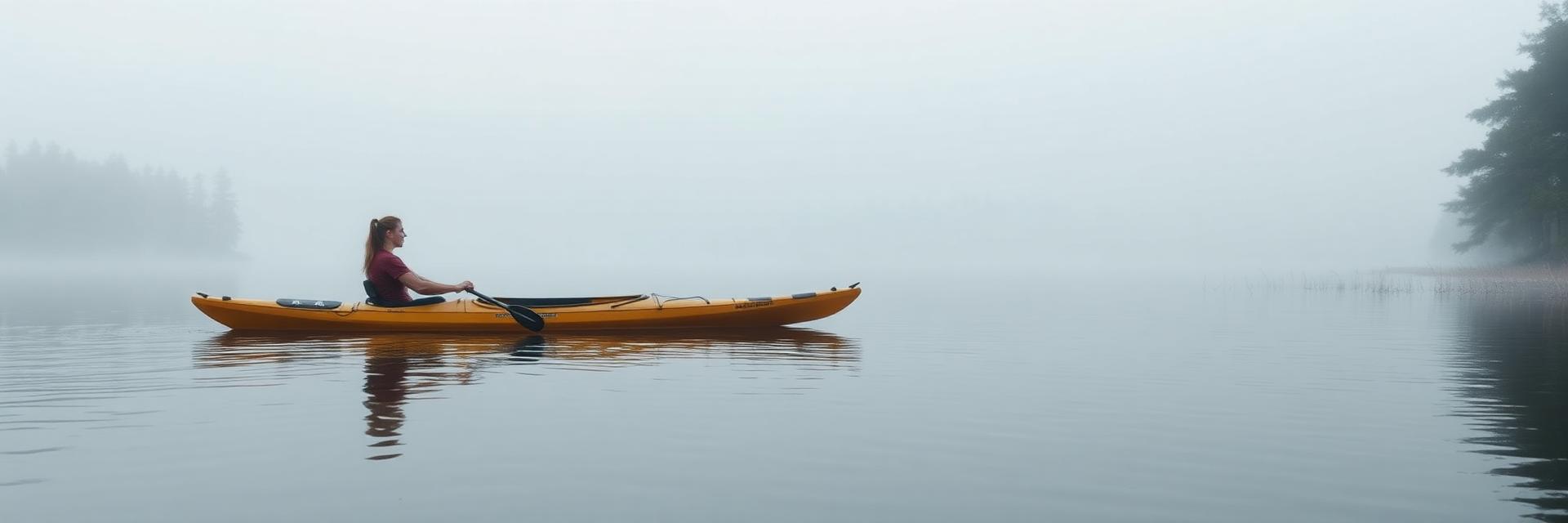

For about six months, the bottom of your lake and the top of your lake are separate worlds.
If your lake is deeper than roughly twenty feet, it spends the summer divided into layers that do not mix. Most people who live on lakes have never heard of this, and it explains more about lake behavior than almost anything else.
The mechanism
Water is densest at about 4°C. Warmer water is lighter and floats; colder water is also lighter and floats, which is why ice forms on top rather than the bottom.
In spring, the whole lake is roughly the same temperature and wind mixes it top to bottom. Then the surface warms. Warm water is lighter, so it stays on top. As the difference grows, wind can no longer mix through it, and the lake settles into three layers.
The epilimnion is the warm surface layer — sunlit, oxygenated, where swimming and most photosynthesis happen. The metalimnion is the transition, where temperature drops sharply over a few feet. This is the thermocline, and it is the thing you swim through when your feet suddenly hit cold water. The hypolimnion is the cold bottom layer, dark, cut off from the atmosphere.
Why the separation matters
Once stratified, the bottom layer receives no oxygen. None from the air, none from photosynthesis, because light does not reach it. But decomposition continues down there all summer, steadily consuming whatever oxygen was present when the layers formed.
In an unproductive lake, there is enough to last the season. In a productive one, the hypolimnion goes anoxic by August. Fish habitat vanishes. And the sediment starts releasing phosphorus it had been holding, which feeds next year's blooms.
Everything difficult about summer lake management happens because of this separation.
Turnover
In autumn, the surface cools. As it approaches the temperature of the bottom layer, the density difference collapses and wind can finally mix the whole lake again. This is fall turnover, and in most lakes it happens over a few days.
The effects are noticeable. Water may briefly go cloudy or smell of sulphur as bottom material redistributes. Fish relocate abruptly. Anglers who cannot find fish for a week in October are usually experiencing turnover.
It also re-oxygenates the bottom and distributes accumulated nutrients through the water column — which occasionally triggers a late autumn bloom, surprising people who assumed bloom season was over.
Then the surface cools below 4°C, becomes lighter than the water beneath, and the lake stratifies again in reverse for winter. In spring, the ice melts, the surface warms toward 4°C, and it mixes again.
The week that decides your summer
How much oxygen is in the bottom layer at the moment it seals off in spring determines whether it survives the season. That is set during the brief window when the lake is still mixing.
Which is why spring measurements matter more than they feel like they should. The May reading nobody wants to pay for is the one that predicts August.
What this means practically
A surface sample describes one layer of a three-layer system. If you are only ever sampling the top, you are not measuring the part of your lake where the problems develop.
Depth matters as much as location. A lake that appears healthy at the surface can be running an anoxic bottom layer that is quietly recharging next year's phosphorus. You cannot see it from a dock, and you cannot infer it from a Secchi reading.
Not every lake stratifies. Shallow lakes mix all summer, and they have a different set of problems. Knowing which kind you have is the first thing to establish, and it costs one afternoon with a temperature profile.