
ToolboxReal-Time MonitoringWater Table Watch
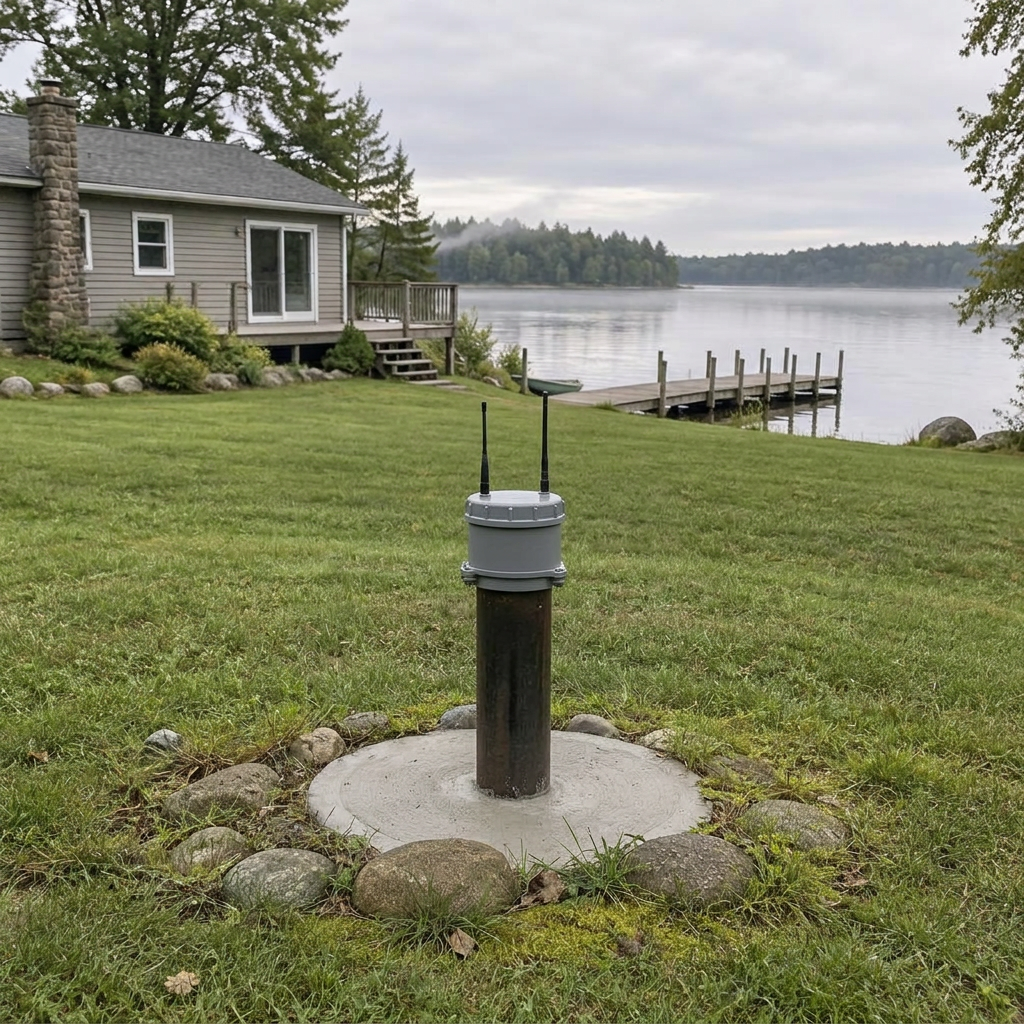
A traditional steel well casing set in a concrete pad ringed with stones, fitted with a modern monitoring cap and two short antennas, in a lakeside home's yard with the house, dock, and a calm lake behind it
Real-Time Monitoring

Water Table Watch

Your well and your lake are the same water. Only one of them tells you early.

$1,700

Checkout arrives with the store connection. Orders attach to the lake on your account.

Overview

Water Table Watch is a continuous groundwater-level monitor for an existing well. It tracks the water table beneath your property and delivers the record into your lake's account alongside your surface-water data.

A lake is groundwater you can see. In most settings, the lake and the groundwater are a single, connected resource, and over the long view the water table is the element that moves first. It responds to drought, withdrawal, and recharge before the lake surface registers any of it.

The monitor measures depth to water with a digitally controlled acoustic signal, so nothing touches the water or interferes with your pump. Readings are accurate to 0.1 ft across a depth-to-water range of 5 to 750 ft, with no instrument drift once calibrated. Readings are taken on a schedule you set, from every 5 minutes to once a day, and with each pump run. A current sensor (a ring that clips around one of the pump's power cables) tells the system when the pump is running. The monitor sends readings by long-range radio to a communication gateway up to 1,800 ft away. The gateway plugs into your home router with an Ethernet cable and uses your internet connection to send data securely to the cloud. It doesn't access other devices on your network.

It fits both common wellhead types. Wells with a well cap, common in northern states, get a new sanitary well cap (the sealed cover on top of your well casing) sized to your well. Wells with a well seal, common in states such as California and Texas, usually already have an open 1/2" NPT port (a standard threaded opening) the sensor screws into, so no new cap is needed. After you order, you send two photos of your wellhead and, for capped wells, the cap's diameter. We confirm the type and fit, then ship.

Installation is five steps on a capped well: plug in the gateway, take off the old cap, fit the current sensor and thread its cable through the new cap, tighten down the new cap, then screw in the monitor and power up. On a sealed well it is three: plug in the gateway, fit the current sensor in the junction box next to the well, then screw in the monitor and power up. Most owners of capped wells have their well contractor do the cap swap and keep the original cap. Available for residential and commercial wells across the U.S.

What's measured

1 parameter

  • Groundwater level (depth to water)
    Unit:
    ft or m
    Reading interval:
    Every 5 minutes to once a day, set by you, plus each pump run

You get

  • Continuous readings streamed to your lake's Portal
  • Charts in the Analytics Hub and configurable alerts (Plus, Lake Admin, PRO)

How it's produced

Instrument
Non-invasive acoustic well-level sensor; nothing touches the water
Accuracy
0.1 ft, no drift once calibrated; USGS-tested
Range
Depth to water 5–750 ft; casing 2–18 in
Well requirement
Submersible pump well with either a well cap (we supply the replacement) or a well seal with an open 1/2" NPT port
Installed by
You, or your well contractor for the cap swap on capped wells
Data transmission
Long-range radio to a gateway up to 1,800 ft away, connected to your home internet
Product category
  • Physical ProductShips to you
  • Availability

    Ships once fit is confirmed from your photos

  • Shipping

    Flat-rate to your front door. Shipping details

  • SKU

    WI-WELL-001

Example result

Example result

−0.8 ft over 30 days

Accuracy 0.1 ft; read alongside lake level

Turnaround

Streams to your Portal continuously once deployed.

What problem does this solve for our lake?

  • Your lake level tells only part of the story. What you see on the surface is connected to something you can't see: the groundwater underneath. Groundwater can flow into your lake, and lake water can flow back into the ground. Which way it moves changes all the time, depending on rain, drought, pumping, and the seasons.
  • The only way to understand that connection is to measure both, continuously. Water Table Watch tracks groundwater levels, so you can see what's happening below the surface alongside your lake-level data. When your lake rises or drops and rain, runoff, and streams don't explain it, groundwater is often the missing piece. Watching groundwater in real time can also give you early warning of where your lake level is headed.
  • Questions this addresses that a surface gauge cannot:
  • Is the lake being fed or drained? A lake sitting above its water table loses water to the ground; one sitting below gains. That direction of flow can change seasonally or over the longer term, and it determines what a dry summer actually costs you.
  • Is nearby withdrawal affecting the lake? Irrigation, municipal supply, and new high-capacity wells are recurring flashpoints for lake communities. Arguing about them without a groundwater record is arguing about impressions.
  • Is drought reaching the aquifer? Surface-water effects lag. The water table typically shows the prevailing trend earlier, which matters for well owners as much as for the lake.
  • Is the shoreline's water supply secure? For lakefront property, well yield and lake health are the same underlying asset.
  • The pairing that does the work is Water Table Watch alongside a LakeLevel Sensor. Two gauges on one system: what goes in, what comes out, and whether they are diverging.

What's included?

  • The acoustic water-level monitor, with a 1/2" port adaptor
  • Current sensor (a ring that clips around one of the pump's power cables) so readings can be tied to pump starts and stops
  • For capped wells: a replacement sanitary well cap, sized to your well, with a port and cord grip for the monitor and current-sensor cable
  • Wellhead check: we confirm your wellhead type, and for capped wells the cap fit, from your photos before anything ships
  • Gateway (the receiver that connects the monitor to the internet): long-range radio link up to 1,800 ft; plugs into your router by Ethernet
  • Readings on a schedule you set, from every 5 minutes to once a day, plus readings with each pump run
  • Pump-related alerts, including water level nearing the pump and increasing frequency or duration of pumping
  • Accuracy of 0.1 ft across a depth-to-water range of 5 to 750 ft; USGS-tested
  • Step-by-step installation guidance for both wellhead types
  • Data flows up to the Lake Pulse cloud and back down into your lake's account, where it can be charted in the Analytics Hub, used to trigger alerts, and shared across your lake community

What's not included

  • A well. This fits an existing submersible pump or monitoring well; it does not drill one.
  • The cap swap (capped wells). Most owners hire their well contractor to remove the existing cap and fit the new one, a short service call.
  • Installation. You install the monitor and current sensor following the instructions provided. If you're not comfortable working around pump wiring, have your well contractor do it. Gateway setup is plug-in.
  • Internet service. The gateway uses your existing home internet.
  • Water quality of any kind. This measures level. For well chemistry, see the Lab Testing side of the Toolbox.
  • Yield or pump testing
  • Regulatory or compliance monitoring
  • Legal determinations about withdrawal rights. A groundwater record supports that argument; it does not settle it.

Requirements

  • An existing residential or commercial submersible pump or monitoring well in the U.S.
  • One of two wellhead types: a well cap (we supply the replacement) or a well seal with an open 1/2" NPT port
  • Access to one of the pump's power cables for the current sensor: at the wellhead on capped wells, or in the junction box next to the well on sealed wells
  • Wellhead details, sent after you order: a close-up photo of the wellhead, a photo from about 10 ft away showing the cap or seal and casing, and, for capped wells, the cap's outside diameter in inches
  • Depth to water between 5 and 750 ft
  • A home router with a free Ethernet port, within 1,800 ft of the well, for the gateway
  • Permission from the well owner, where that is not you
  • A recorded reference elevation at install, so readings tie to the lake record
  • A Plus, Lake Admin, or PRO subscription. Syncing a real-time device to a Lake Pulse account requires one of these tiers.
  • Contact the Lake Pulse Boathouse if you have questions.
What you get back

Results

  • A continuous groundwater-level record for your property
  • The relationship between lake level and water table, visualized together rather than separately
  • Early warning on drought or flooding, since the aquifer responds before the lake surface
  • An evidence base for conversations about the impact of nearby withdrawal
  • Context for well yield and shoreline water security
  • Data flows up to the Lake Pulse cloud and back down into your lake's account, where it can be charted in the Analytics Hub, used to trigger alerts, and shared across your lake community
  • Results are found in your lake's Portal, accessible only to Plus, Lake Admin, and PRO subscribers

Pro tips

  • Shoot the photos in daylight. The close-up identifies the cap or seal type, fasteners, and any open port; the 10 ft shot shows the casing and what connects to it, such as the electrical conduit and vent.
  • Measure the cap across its widest point, in inches, to the nearest 1/8 in. Measure the cap, not the casing.
  • Keep the original cap. If the monitor ever comes off, the old cap goes back on.
  • Ask your contractor to record the static water level at install (depth to water when the pump has been off for a while) and the reference elevation. Groundwater level relative to lake level is the whole measurement, and it is meaningless without a common datum.
  • Buy it with a LakeLevel Sensor, not instead of one. A single gauge on either side answers half the question; the two together answer it.
  • Start before the dispute. A groundwater record acquires its value from length. Installed the year a high-capacity well is proposed, it proves nothing.
  • Read the timed readings for the trend. Every reading is tagged by type (timed, pump start, pump stop, recovery), so pumping drawdown can be set aside to show the true rise or fall of the water table.
Results sync to the Portal for Plus, Lake Admin, and PRO subscribers

Results from this product land in your lake's shared record in the Portal — next to everything else your lake has ever measured, instead of in an inbox.

Compare subscriptions

About these results

Every reading is time-stamped and tagged by type as it is recorded. Readings come from one sensor at one well; conditions elsewhere will differ, sometimes sharply and within hours. The sensor measures with a digital acoustic signal and does not touch the water, so it does not drift or foul once calibrated. It can occasionally fail, usually because of a wear part such as the battery or microphone cable. Gaps in the record are shown as gaps, never filled in. Sensor values are field measurements, not laboratory analyses. Alerts are notifications of a reading, not a safety determination. Results can help you make decisions about your groundwater supply and water use, but no result is definitive for every place and time. It is always good practice to check with your state or local authorities.

Questions on this?

Our team can help you choose the right solution for your lake, explain how results sync to your Portal, or point you to the right subscription.

Same aisle

More in Real-Time Monitoring.

See all

LakeTemp Sensor

Temperature is the lake's master variable. This is the cheapest way to stop guessing at it.

Measures: Surface water temperature

Turnaround: Streams to your Portal continuously once deployed.

Ships in 3 business days

$150
View

LakeLevel Sensor

Ninety-six readings a day, to a fifth of an inch, from a sensor nobody has to visit.

Measures: Water level

Turnaround: Streams to your Portal continuously once deployed.

Ships in 3 business days

$1,500

View

Shoreline Weather Station

Your shoreline's weather, measured where you are and kept to yourself.

Measures: Temperature, Humidity, Wind speed +11 more

Turnaround: Streams to your Lake Pulse account continuously once deployed.

Ships in 3 business days

$349

View
A woman paddling a kayak alone across a misty morning lake

Lake Pulse

Every lake deserves a permanent record. Yours can start this morning.

Get started